
The best time to buy health insurance is when you don't think you need it.

Here's decoding the fine print so that you know exactly what your health insurance policy covers, what it doesn't and the policy conditions that deserve your attention before you need to make a claim.

The National Health Authority (NHA) is promoting the National Health Claims Exchange (NHCX) to standardise and simplify health insurance claims processing in India, aiming for a seamless and reliable digital infrastructure similar to UPI.

'Buy early and review the sum insured regularly.'
'Combining individual or family policies with corporate cover, along with top-ups and wellness programmes, can help maintain strong health protection throughout life.'

Even as non-life insurers reported muted premium growth in October, standalone health insurers saw a robust 38 per cent year-on-year (Y-o-Y) surge. This growth was driven by pent-up demand in the retail health insurance segment.

Marriage, childbirth, dependent parents and ageing increase the cover a person needs.

Many claim disputes arise not because the insurer refuses to pay but because policyholders don't know the claim process, miss important documents or misunderstand what their policy covers.

Tier-II, Tier-III, and rural regions accounted for 62 per cent of all new health insurance policies sold by insurers so far in 2025-26 (FY26), according to a Policybazaar report. These regions are also witnessing a rise in the sum assured opted by customers.
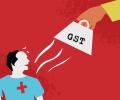
Reduction of GST on health insurance premium from 18% to 0% looks like a straight 18% reduction in what consumers pay. The truth, however, is...
'Go for a base cover of Rs 10 lakh and then buy a super top-up of Rs 90 lakh.'
'The retail industry is still growing in double digits.'

Full exemption for all health insurance premiums and reinsurance or a reduction in the GST rate from 18% to 5% on health insurance services is likely.

Health insurance premium growth has slowed after touching record highs during the Covid-19 pandemic due to tapering demand from retail consumers amid affordability issues. According to General Insurance Council data, health insurance premiums grew by 10.44 per cent year-on-year (Y-o-Y) in the Apr-Jan period of FY25 in comparison with 20.79 per cent in the year-ago period. It was around 23.57 per cent in FY23, and 25.89 per cent in FY22.
Purchase health insurance at an early age, before you incur a disease, as this makes access to health insurance difficult and raises the premium significantly.

Young buyers often underestimate future health risks.

Follow these steps to avoid last-minute surprises while claiming your mediclaim -- via cashless or reimbursement method, says P V Subramanyam

'Healthcare costs in India rise by 10 to 14% annually, causing treatment costs to double roughly every 5-7 years.'

It is similar to top-up health insurance plan, but provides for one or more claims cumulatively crossing the threshold limit.

The Insurance Regulatory and Development Authority of India (IRDAI) has removed the age cap on buying health insurance policies, effective from April 1, 2024. Earlier, individuals were restricted to purchasing new insurance policies only until the age of 65. However, after the recent changes that have come into effect from April 01, 2024, anyone, regardless of age, is eligible to purchase a new health insurance.

Do you have health insurance/mediclaim queries? Rakesh Kaul, chief distribution officer, Edelweiss General Insurance, will answer your queries.

State-owned Life Insurance Corporation (LIC) is not keen on a composite license but it is looking to buy less than 50 per cent stake in a standalone health insurance company to enter the health insurance segment such that they have a say in the management of the company, without having to run the company, sources in the know said. "LIC doesn't need a composite licence. "Even if it is introduced, they will not opt for it.

Industry experts believe that health insurance companies are unlikely to experience business cannibalisation due to the central government's decision to extend health coverage to people aged 70 and above, regardless of their income level, under the Ayushman Bharat scheme. On Wednesday, the Union Cabinet expanded the Ayushman Bharat Pradhan Mantri Jan Arogya Yojana (AB-PMJAY) to include all senior citizens aged 70 and older. This move is expected to benefit nearly 45 million families, comprising 60 million senior citizens, by providing Rs 5 lakh in free health insurance coverage per family.

Sanjib Jha, CEO, Coverfox Insurance Broking, answers your health and auto insurance related queries.

Ask rediffGURU and PF expert Milind Vadjikar your insurance, stocks, mutual fund and personal finance-related questions.

Jio Financial Services and Munich-based Allianz Group have signed a binding agreement to establish a 50:50 joint venture for general and health insurance in India, building on an earlier reinsurance partnership.

Prudential plc has announced its acquisition of a 75 per cent stake in Bharti Life Insurance for approximately 3,500 crore, a strategic move to secure majority ownership in the Indian life insurance market. This acquisition necessitates Prudential reducing its holding in ICICI Prudential Life Insurance to below 10 per cent.

Proposal forms are often filled by the agent. Check the form after it is filled.

'Many policyholders do not understand that non-medical expenses, cosmetic treatments, and certain other procedures are not covered by health insurance policies.'

Policy owners need to avoid errors on their part to prevent claims from being denied.

As heart disease increasingly impacts young Indians, understanding the complexities of health insurance, including higher premiums, waiting periods, and the benefits of specialised cardiac policies, becomes vital for financial protection.
The insurance regulator's move to prod insurance companies to sell health products to all age groups, including those above 65, is aimed at increasing penetration though there would be challenges on pricing due to higher risk perception, experts said. While there was no regulatory cap on age for health insurance policies, most companies had an internal policy which did not allow them to sell health insurance products to persons over 65.
Ask rediffGURU and PF expert Milind Vadjikar your insurance, stocks, mutual fund and personal finance-related questions.

The move by the insurance regulatory body aims to create a more inclusive healthcare ecosystem in India and to encourage insurance provider companies to diversify their product offerings.
The average ticket size of retail health insurance in India has increased by nearly 48 per cent over 6 years due to elevated medical inflation and increased demand for higher coverage policies among policyholders. According to data by online insurance broker PolicyBazaar, the average ticket size of retail health insurance in India has increased to Rs 26,533 so far in FY24, up 48.22 per cent from Rs 17,900 in FY19.

New business premium of life insurance companies grew 18 per cent year-on-year (Y-o-Y) to Rs 35,417 crore in February, driven by robust growth at the state-owned Life Insurance Corporation of India (LIC) due to a favourable base.

Make sure that the waiting period on pre-existing diseases does not exceed two years. Avoid policies that come with room rent and ICU capping, suggests Sanjay Kumar Singh.

Roopam Asthana, CEO and whole-time director, Liberty General Insurance Ltd, will answer your queries on HEALTH insurance and AUTO insurance.

Private hospitals accounted for 30.8 per cent of current health expenditure in FY23, while pharmaceuticals and medical goods contributed more than 21 per cent, underlining continued dependence on private healthcare and medicine spending.

Roopam Asthana, CEO and whole-time director, Liberty General Insurance Ltd, answers your queries on HEALTH insurance and AUTO insurance.

If reimbursement becomes unavoidable, submit a complete file at the earliest.
